Four Seasonal Constellations to Learn First: A Beginner's Night-Sky Guide
Most people who decide to learn the night sky begin the same way: they point a phone at a bright star, read the name, and have forgotten it by morning. The app isn't the problem. A name floating on its own has nothing to attach to. Constellations stay in your memory when they're tied to something you already recognise — a shape low over the roof opposite, a star you can find on any clear night, a landmark you can hop from.
Four are enough to start. One for each season, each bright enough to survive suburban glow and simple enough to learn in a single evening. Once you have them, the sky stops being a scatter of dots and becomes a place with neighbourhoods.
Why a Handful of Anchors Works Better Than an App
Astronomy apps are excellent references. They are poor teachers, because they answer a question you haven't yet learned to ask. The skill you actually want is star hopping: moving from a pattern you know to one you don't, one jump at a time. That only works if the starting points are secure.
A good anchor constellation has a few practical qualities. Look for one that:
- is bright enough to see from a town garden, not just a dark-site field;
- has a simple, unmistakable internal shape — a cross, a square, a belt;
- sits near other things worth finding, so it repays a second visit;
- is large enough that you can't miss it once you know where to look.
Learn four of these properly and you will spend far less time squinting at a screen and far more time actually looking up.
Spring: Ursa Major, the Dipper and the Pointers
Start with the Big Dipper, seven bright stars making a bowl and a handle. It isn't a constellation in its own right but an asterism inside Ursa Major, the Great Bear — a distinction that matters less than the shape, which is the most recognisable in the northern sky. From most of Europe and North America it never sets; it swings low on autumn evenings and rides almost overhead in spring.
Finding Polaris
Take the two stars at the end of the bowl, Merak and Dubhe, and draw a line from Merak through Dubhe. Extend it about five times the distance between them and you arrive at Polaris, the North Star. This one hop is the single most useful thing a beginner can learn. Polaris sits almost exactly above the north point of the horizon, at a height equal to your latitude — roughly 40 degrees up if you're near 40 degrees north.
Where to Go Next
Follow the curve of the handle away from the bowl and you come to Arcturus, a bright orange star in Boötes. Keep the same curve going and you reach Spica in Virgo. From the bowl, drop southward on spring evenings to find Leo, whose backwards question mark of stars — the Sickle — is crowned by Regulus. The Dipper is the gateway to all three.
Summer: Cygnus and the Summer Triangle
On a July or August evening, look high overhead for three bright stars forming a large triangle: Vega, Deneb and Altair. That's the Summer Triangle, and each star belongs to a different constellation. The faintest of the three in most skies, Deneb, marks the tail of Cygnus, the Swan.
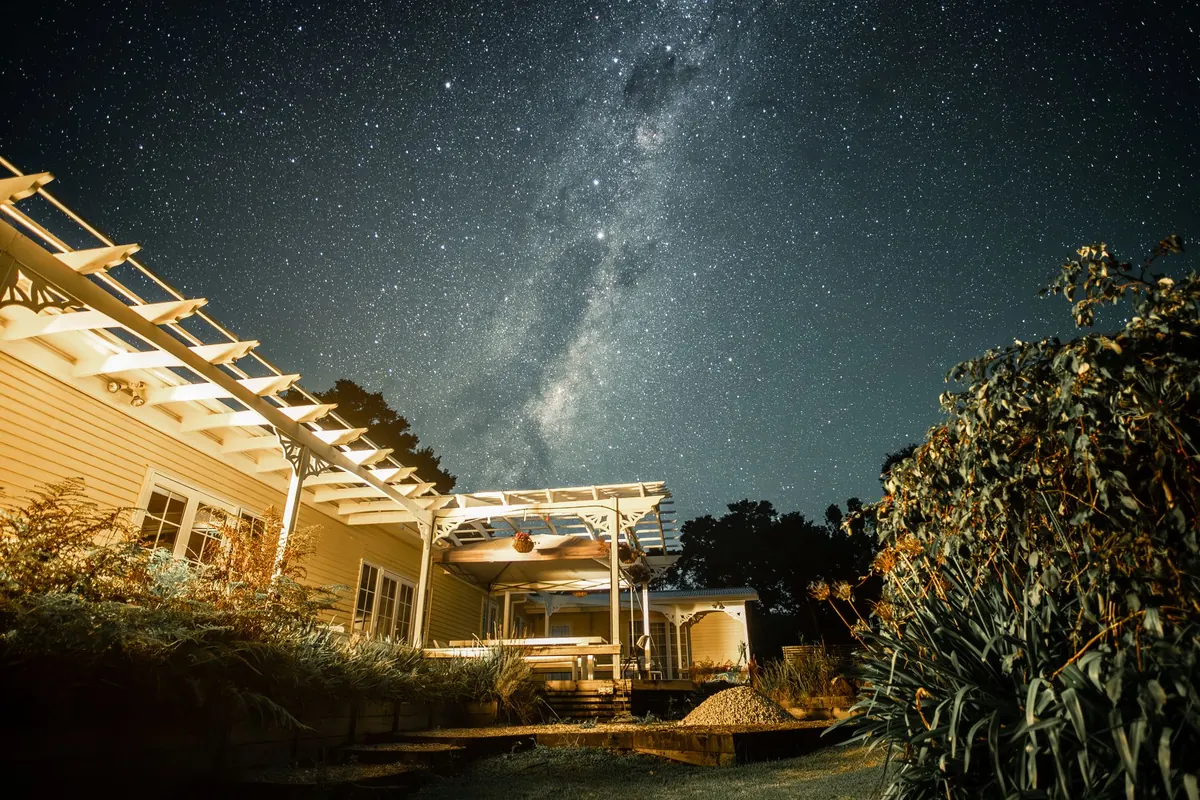
Cygnus is a cross of stars flying along the Milky Way, which in summer runs like a band of faint smoke from north-east to south-west. Deneb sits at the head of the cross and Albireo at the foot. Look carefully at Albireo through binoculars and you'll see why people keep coming back to it: a gold star and a blue one, close together, one of the finest colour contrasts in the sky.
Once you can find the cross, you have a map of the Milky Way's richest region. Sweep binoculars along the swan's body on a moonless night away from streetlights and you'll find star fields dense enough to look like spilled sugar.
Autumn: Pegasus and the Great Square
Autumn evenings offer a quieter sky, and one very useful shape. The Great Square of Pegasus is a large, near-perfect quadrilateral of four stars — Markab, Scheat, Algenib and Alpheratz — rising in the east through the evening and passing overhead after midnight.
One small detail is worth knowing: Alpheratz, the corner nearest Andromeda, actually belongs to Andromeda rather than Pegasus. Astronomers kept it there when the constellation boundaries were fixed, and it's a reminder that the sky's borders are a human convention, not a physical fact.
From Alpheratz, follow Andromeda's two arcs of stars away from the square. Somewhere along that chain is M31, the Andromeda Galaxy — a faint oval smudge, visible to the naked eye from a genuinely dark site and easy in binoculars from a suburb. It is the most distant object most people ever see without a telescope, and finding it the first time feels like a small private achievement.
Winter: Orion, the Sky's Best Landmark
If you learn only one constellation, make it Orion. It rises in the east on late autumn evenings and dominates the southern sky in January and February, and it is so obviously a figure that nearly every culture on Earth has given it a name.
Three stars in a short, even row make the belt: Alnitak, Alnilam and Mintaka. Above them, Betelgeuse glows orange-red at the shoulder; below, Rigel blazes blue-white at the foot. Between the belt and the sword hangs the Orion Nebula, a soft grey-green patch that resolves into shape through any pair of binoculars.
The belt is a signpost. Extend the line of the three stars down and to the left and you reach Sirius, the brightest star in the night sky. Extend it up and to the right and you arrive at Aldebaran, the orange eye of Taurus, with the V-shaped Hyades cluster around it and the Pleiades further along the same line. Two jumps, two constellations, no app required.
A Simple Practice Plan for Your First Month
Learning one constellation per session beats trying to absorb a whole sky at once. Try this sequence:
- Go out about an hour after full darkness and give your eyes fifteen minutes away from screens and bright lights. Then find just one anchor.
- Sketch it on paper. Rough is fine. Mark where it sits relative to a chimney, a tree or the corner of your building.
- Go back inside and return an hour later. Note how far the whole pattern has shifted west. The sky turns roughly 15 degrees each hour, which is why a constellation high at 10 pm is lower and further west by midnight.
- Make one hop from your anchor — Dipper to Arcturus, belt to Sirius, square to the Andromeda Galaxy.
- Learn one extra detail attached to that anchor: a double star, a nebula, a colour contrast. Details are what make you return.
Practical Notes Before You Step Outside
Check the Moon phase first. A bright Moon washes out faint stars and makes the Milky Way invisible; the week around new Moon is the time for galaxies and clusters. A red torch preserves your dark adaptation better than a white one, and a folding chair will keep you outside far longer than enthusiasm alone. Dress warmer than you think you need to — standing still in a field cools you quickly.
Bear in mind that the seasons drift. Because the sky shifts about two hours earlier each month, a constellation overhead at 11 pm in January is overhead at 9 pm in February. So if you miss Cygnus this August, you'll catch it again next summer without waiting a full year. Keep a short note of what you found and when, and by this time next year you'll have a personal map of four anchors, several dozen stars and a handful of objects you can point out to anyone who asks.
Photo: Pexels / Pixabay