How to Set Up a Horizontal Sundial for Your Latitude and True North
A sundial that reads fifteen minutes off is not broken. It is a sundial. That gap between the shadow on the plate and the number on your phone is the whole point of the exercise: it shows how your local sky relates to the clock on the wall. Setting up a horizontal dial properly means getting three things right — the angle of the gnomon, the direction of true north, and the corrections you apply when you compare the two times. Do them in that order and the instrument will do the rest.
What the gnomon is actually doing
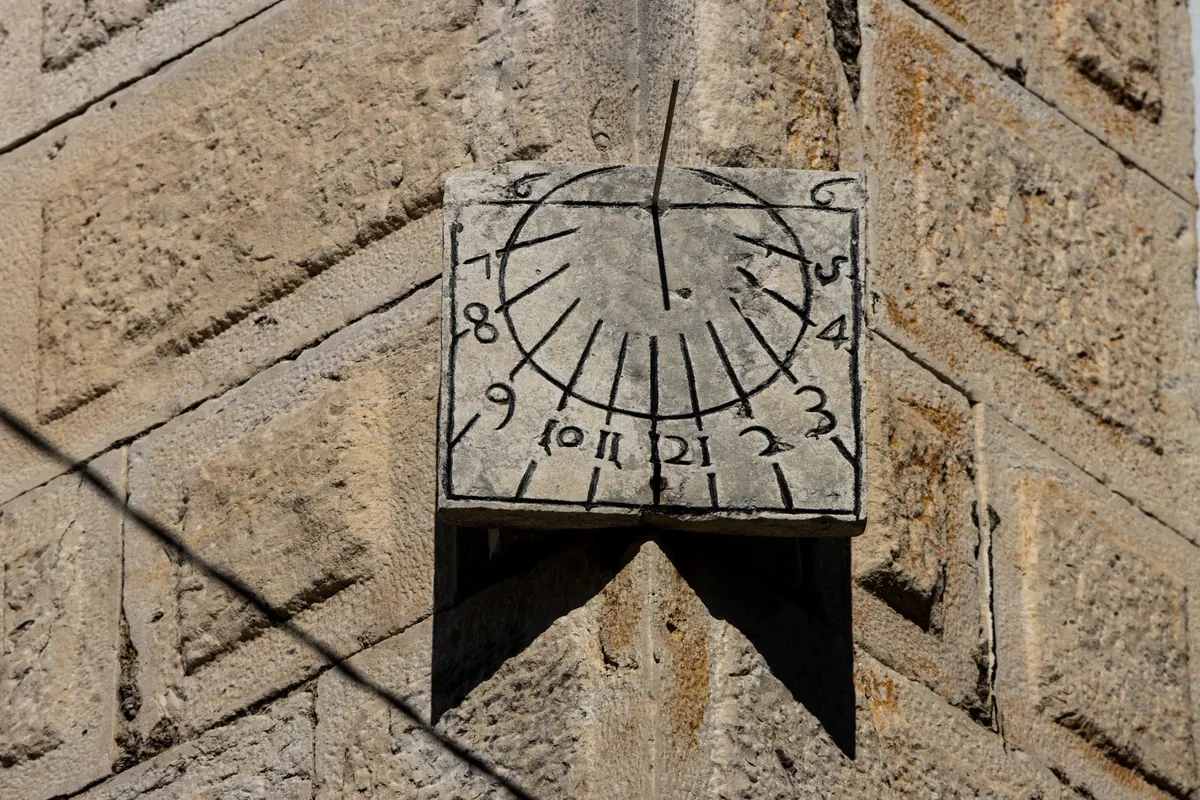
The raised fin on a horizontal dial — the gnomon, or style — has one job: to sit parallel to Earth's rotation axis. Its straight upper edge casts the shadow you read, and that edge should point at the celestial pole. In the northern hemisphere that means it points north and rises at an angle equal to your latitude.
This is why a dial made for Rome, at roughly 41.9° north, misbehaves if you take it to Edinburgh at 56°. The error is not constant; it changes through the year, which makes it maddening to diagnose after the fact. Latitude is the first number you need, so fix it before anything else.
Because the style leans, the shadow does not sweep the plate at a tidy 15° per hour. On a horizontal dial the hour lines fan out unevenly, spreading wider the further you get from noon. The relationship is tan θ = sin φ × tan H, where φ is your latitude, H is the sun's hour angle and θ is the angle of the hour line measured from the noon line. At the equator the lines are exactly 15° apart. At 50° north, the 3 p.m. line sits about 38° from noon instead of 45°.
Setting the gnomon angle
Your latitude to a tenth of a degree is plenty. A GPS reading, a decent map or an online coordinate lookup will all do; the difference between 51.4° and 51.5° is far thinner than a pencil line at the tip of a shadow.
The angle to set depends on the shape of your gnomon. If it is a rod, the axis of the rod rises at your latitude above the horizontal. If it is a triangular plate, it is the top edge — the hypotenuse — that must reach that angle, because that edge is what casts the reading shadow.
- Establish your latitude and write it down.
- Identify the straight edge of the gnomon that will cast the time shadow. Ideally this edge is thin and sharp, not a broad face.
- Mark the angle on the north-south centreline of the plate, measuring up from the horizontal surface.
- Mount the gnomon and check the result with a protractor or a digital inclinometer laid along the style.
- Confirm that the style's edge lies in the vertical plane running north-south. A style that is tilted sideways as well as upward will never read correctly.
Finding true north
Most badly performing garden dials are not badly made. They are simply pointed at magnetic north. A compass needle swings toward magnetic north, which can sit several degrees away from true north, and the offset varies by location and drifts slowly over the years. Forget the needle for the final alignment and use one of these methods instead.
The equal-shadow method, with no equipment
This is the classic technique and it is accurate enough for any garden dial.
- On a clear morning, set the dial plate on a flat, level surface where the sun will reach it all day.
- Stand a straight vertical rod at the centre point and draw two or three concentric circles around its base.
- Through the morning, mark each point where the tip of the shadow crosses a circle.
- In the afternoon, mark where the tip crosses the same circles again.
- Join each morning mark to its afternoon partner and bisect that line. The bisector runs true north-south.
The geometry works because the sun reaches equal altitudes at equal times either side of local noon. Anywhere north of the tropics the noon shadow points due north, so the bisector also tells you which end of your line is north.
Polaris, after dark
In the northern hemisphere, Polaris sits within about a degree of the celestial pole. Sight along a line to it, mark the direction on the ground, and rotate the dial until the noon line matches. One degree of error translates into a few minutes of reading error at most — acceptable for a decorative dial, though the shadow method is better if you want precision.
Compass and map, with caution
If you use a magnetic compass, apply the current declination for your area, which you can look up for the present year rather than trusting an old figure printed in a guidebook. If you use a map, remember that grid north on a projected map is not always exactly true north. Keep phones and steel tools away from the compass while you take the bearing.
Marking the hour lines
Level the plate before you rotate it, and check the level again afterwards. A plate that tilts by even a degree distorts every hour angle on it, and the error grows toward morning and evening.
Once the noon line runs true north-south and the style is set at your latitude, calculate the hour angles with the formula above and scribe them from the noon line. A few values for latitude 45° show how the spacing opens up: the 1 p.m. line sits 10.7° from noon, 3 p.m. sits 35.3°, and 5 p.m. sits 69.3°. At higher latitudes the fan becomes dramatic; in northern Scotland the early and late hours crowd toward the edge of the plate.
The 6 a.m. and 6 p.m. lines fall at 90° from noon and lie along the east-west line of the plate. Lines beyond that point only matter in summer, when the sun rises before six and sets after six.
From sundial time to clock time
Your dial reads apparent solar time. To compare it with a watch, apply three corrections.
- Longitude. Clock time is tied to a standard meridian — 15° east for Central European Time, for example. Each degree you sit away from it shifts solar time by four minutes. West of the meridian, the sun arrives later, so add the difference.
- Equation of time. Earth's orbit and axial tilt make the sun run fast or slow against mean time by up to roughly a quarter of an hour through the year. The value swings between about −14 and +16 minutes; an almanac or a printed table gives it for any date.
- Daylight saving. Add an hour while summer time is in force.
Take Rome, at 12.5° east, on the Central European standard meridian of 15° east. The difference is 2.5°, or ten minutes, added because Rome lies west of the meridian. In mid-February the equation of time is about −14 minutes, meaning the sundial lags the mean sun. So clock time equals sundial time plus 24 minutes: a dial reading 11:40 corresponds to about 12:04 on the wall. In July you would add the daylight-saving hour on top.
Before you fix it in place
Live with the dial for a day before drilling anything. Set it up temporarily, check the reading at local apparent noon — the moment of the shortest shadow — and confirm that the shadow falls exactly on the noon line. Re-check the level, nudge the rotation if needed, and only then anchor it.
Keep the installation away from walls, fences and trees that cast their own shadows during the hours you care about, and make sure the style's edge is the part doing the work; a thick gnomon casts a wide band, and you should read from the shadow of its upper edge. Then check again in a different season. A dial that is right in June and right in December is right for good.
Photo: Efrem Efre / Pexels