Why Your Sundial Is Wrong: 7 Common Setup Mistakes and Fixes
A sundial is one of the few instruments that tells you when it is wrong—if you know what to look for. The shadow lands, you squint, and the reading is off by twenty minutes or a full hour. Before you blame the dial, check the setup. Most errors come from a short list of predictable mistakes: a base that looks flat but is not, a noon line aimed at magnetic rather than true north, a gnomon set to the wrong angle, or a reading compared to the wrong kind of time. The good news is that each fault has a practical fix, and most take less time to correct than the original installation.
1. The dial is not truly level
A horizontal sundial has to be horizontal in every direction, not just front to back. It is easy to set a dial on a table, glance at it, and decide it looks fine. Wood warps, stone settles, and tripod legs sink into soft ground. A base that is off by only a degree or two can shift the shadow enough to matter, especially near midday when the shadow moves slowly and small errors are easy to miss.
Use a spirit level across two perpendicular directions—left to right and front to back. Then check again after an hour. If the bubble moves, the base is unstable. Shimming with thin wedges under a stone or metal base works well; a portable dial on a tripod needs firm ground and a locking head. For a permanent installation, set the dial on a solid footing and recheck the level after the first temperature change or hard rain. A dial that was level in the workshop is not automatically level in the garden.
2. The noon line points at magnetic north, not true north
This is the most common alignment error. A compass points to magnetic north, which is usually not the same as true north. The difference—magnetic declination—varies by location and changes slowly over time. If you aim a dial’s noon line with an uncorrected compass, the whole hour scale can be rotated by several degrees.
Use a true-north method instead. In the northern hemisphere, Polaris gives a good nighttime reference. In daylight, mark the shortest shadow cast by a vertical rod around local solar noon; the line from the rod to that mark points along the meridian. A reliable local map or a known true-north reference also works. Do not trust a decorative compass rose printed on the dial unless you have checked it. Once the noon line is correct, rotate the dial so the gnomon’s shadow falls on the noon mark at solar noon, then secure the base so it cannot twist.
3. The gnomon angle does not match your latitude
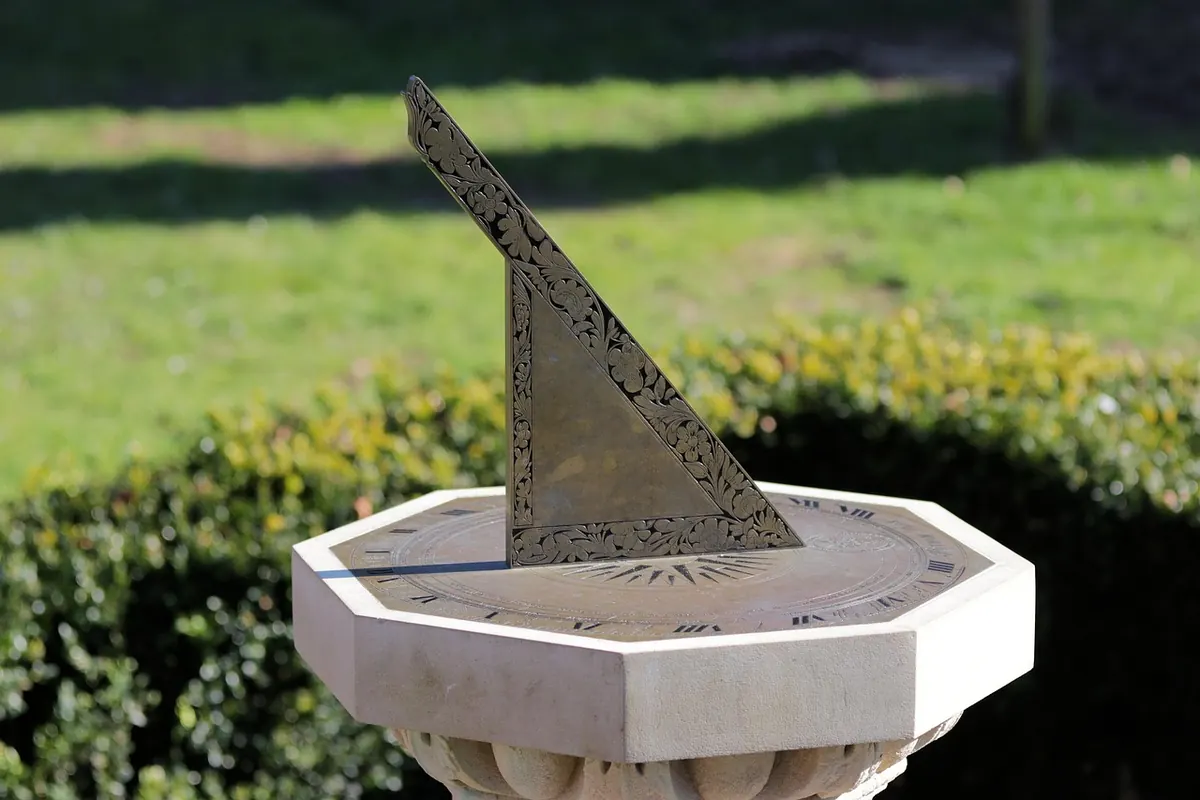
The gnomon—the shadow-casting edge—must be parallel to Earth’s axis. For a horizontal dial, that means the angle between the style and the horizontal plane should equal your latitude. A dial made for Rome will not read correctly in Oslo, and a decorative dial set at 45 degrees because it looks balanced will be wrong almost everywhere.
Check the angle with a protractor or an inclinometer. If the dial came with instructions, confirm which surface the angle is measured from; vertical and equatorial dials use different geometry. A horizontal dial’s style should rise from the plate at your latitude angle and point toward the celestial pole. If the gnomon is adjustable, loosen it, set the angle, and tighten it firmly. If it is fixed and the angle is wrong, the dial may still be usable as a ornament, but not as a reliable timepiece.
4. You are comparing solar time to clock time
A sundial reads apparent solar time, which is based on the Sun’s actual position. A clock reads standard time, which is based on a time zone and a mean solar day. Those are not the same thing. The difference includes the equation of time—a variation of roughly a quarter of an hour or less depending on the date—and a longitude correction if you are not on the standard meridian of your time zone.
To compare fairly, convert the dial reading step by step. Note the dial’s solar time, apply the equation of time for that date, adjust for your longitude within the time zone, and only then compare with the clock. If you skip these corrections, a perfectly set dial can look ten or fifteen minutes fast or slow. That is not a setup fault; it is a difference in time scales.
Mistake 5: Daylight saving time is shifting the reading
Daylight saving time adds another whole hour to the confusion. If your region observes it, your clock is one hour ahead of standard time during the summer months. A dial reading 1:00 p.m. solar time may correspond to 2:00 p.m. on the clock before other corrections. Check whether daylight saving is active, and remember that the start and end dates vary by country and can change. The fix is simple: subtract the extra hour when converting from clock time back to solar time, or add it when going the other way. Write the correction on a small card near the dial so guests do not misread it.
6. The shadow is blocked, bent, or misread
Look at the shadow itself. A gnomon that is bent, twisted, or thick casts a fuzzy edge. Nearby trees, buildings, window frames, and even a hanging plant can cut into the sunlight. The result is a reading taken from the wrong part of the shadow. On a dial with a broad style, read the center of the shadow’s edge rather than the darkest patch; the penumbra can be several minutes wide.
Keep the style straight and its edge sharp. Trim or move whatever blocks the sun during the hours you care about. Read the dial from directly above or at a consistent angle; viewing a horizontal dial from the side introduces parallax. If the dial sits near a wall, check how the wall’s shadow moves through the day. A dial that reads well at noon may fail completely in the afternoon.
7. The dial type or installation does not match the site
Not every dial belongs on every surface. A horizontal dial needs a level plate. A vertical dial needs a wall facing the correct cardinal direction, and a wall that faces southeast, southwest, or another intermediate direction needs hour lines calculated for that declination. A portable dial must be set for the local latitude and oriented correctly before it can work. Mounting a garden dial on a wall, or using an equatorial dial without adjusting its angle, produces errors that no amount of leveling will fix.
Identify the dial type first. Check the instructions or the hour-line layout. If the wall is not close to true south or true north, a standard vertical dial will be wrong for much of the day. Either use a dial designed for that wall or accept that it is decorative. For portable dials, confirm the latitude setting and the north alignment every time you move it.
A quick field checklist before you change anything
Before you adjust the hour lines or buy a new dial, run through this sequence. It catches most faults in a few minutes and saves an afternoon of guessing.
- Level: check the plate in two directions, then check the base for stability.
- North: confirm the noon line against true north, not magnetic north.
- Angle: verify the gnomon is set to your latitude and points toward the celestial pole.
- Time: convert solar time to clock time with the equation of time, longitude, and daylight saving.
- Shadow: clear obstructions, straighten the style, and read the shadow edge consistently.
- Type: make sure the dial is designed for its mounting surface and orientation.
Fix one item at a time and note the reading at solar noon. A sundial is a patient instrument; it will show you exactly where the setup is off, provided you give it a level base, a true-north line, the right angle, and an honest comparison with the clock.
Photo: ShepherdMedia / Pixabay